- Home
- All Filaments
- Filazoo PLA+ Filament – Tough, Low-Warp Everyday Printing, 1.75mm, 1kg
1
/
of
11
Free Shipping
15-Day Easy Returns
Lifetime Product Support
Secure Payment

Ends in
00
D
:
00
H
:
00
M
:
00
S
Filazoo PLA+ Filament – Tough, Low-Warp Everyday Printing, 1.75mm, 1kg
$14.17
/roll
(Lowest price for 20+ rolls)
MSRP:$18.90
Save $4.73 per kg
Buy more, save more.
View bulk pricing ›
1 pcs
Free Shipping
5 pcs
$16.06
15% OFF
10 pcs
$15.12
20% OFF
20 pcs
$14.17
25% OFF
0 rolls
Color
Quantity
Price

Black

Gray

White

Skin Tone

Red

Orange

Yellow

Green

Blue

Pink
Subtotal
0 items
📍 Your location: United States
Black —Ships internationally
Estimated Sep 24 – Oct 6
Couldn't load pickup availability
Payment
Print stronger everyday parts with Filazoo PLA+ Filament. Designed to offer improved toughness and reduced brittleness compared with standard PLA, it provides a practical balance of strength, detail, and easy printability.
Its consistent diameter and neatly wound spool support stable feeding and smooth extrusion, making it a dependable choice for functional prototypes, tools, toys, organizers, mechanical models, and everyday creative projects.
Key Features
- Improved toughness compared with standard PLA
- Less brittle for more durable printed parts
- Strong layer adhesion
- Smooth and consistent extrusion
- Easy to print with low warping
- Neatly wound for dependable feeding
- Suitable for functional and decorative models
- Available in 10 versatile colors
Diameter:
1.75 ± 0.02 mm
Net Weight:
1 kg per spool
Gross Weight:
Approximately 1.3 kg per spool*
Filament Length:
Approximately 330 m
Care Tip:
Store the filament in a sealed bag or dry box with fresh desiccant. If you notice popping, excessive stringing, bubbles, or an uneven surface, dry the filament before printing.
Share
Need to Know
Product Features
Service
- Free Shipping
- 15-Day Easy Returns
- Lifetime Product Support
Payment
Secure checkout is available with these payment methods:


Filazoo PLA+ Filament – Tough, Low-Warp Everyday Printing, 1.75mm, 1kg
$18.90
Subtotal:
$18.90
$18.90
Related Model
-
-
-
Farmhouse Coin Bank
23 4 -
Rocket Stress Relief Toy
20k 215
FAQ
What is PLA+ filament?
PLA+ is a modified PLA designed for improved toughness and reduced brittleness while keeping the easy printing behavior of standard PLA. It's the material we recommend for parts that get handled or loaded rather than just displayed — see PLA+ vs. PLA Basic for the full comparison.
What is the difference between PLA and PLA+?
Standard PLA is easy to print but relatively brittle. PLA+ is formulated for a better balance of toughness, strength, and printability, which makes it the better pick for functional everyday parts. Is the upgrade worth the extra cost? walks through when standard PLA Basic is still the smarter choice.
Is Filazoo PLA+ suitable for beginners?
Yes. Low warping and undemanding print settings make PLA+ suitable for beginners as well as experienced users. If this is your first roll, our filament guide for a first print covers the basics, and 10 Gridfinity organizer prints to start with PLA+ is a good first project list.
What nozzle temperature should I use?
Start at approximately 215°C. Use 205–215°C at 50–100 mm/s, or 215–245°C at 100–200 mm/s, then adjust for your printer and model. A temperature tower settles it in one print — here's how to read the result.
What bed temperature is recommended?
A heated bed at 50–60°C is recommended. On an unheated bed you'll want a suitable adhesive to improve first-layer adhesion. If the first layer is giving you trouble either way, our bed adhesion checklist works through the causes in order.
What printing speed should I use?
Start at 60–100 mm/s for reliable results. A compatible high-speed printer can go faster once nozzle temperature, flow rate, cooling, and acceleration are calibrated — start with a calibration print rather than raising the speed blind.
Is PLA+ stronger than standard PLA?
Generally, yes — PLA+ is formulated to be tougher and less brittle than standard PLA. Real part strength still depends on print orientation, wall thickness, infill, temperature, and layer adhesion. If parts are breaking along layer lines rather than across them, the filament isn't the problem: see why parts split along layer lines.
Is PLA+ suitable for functional parts?
Yes, for light-duty functional parts: prototypes, organizers, tools, toys, brackets, and everyday items. Don't use it for safety-critical or high-temperature applications without testing. For parts that need real heat or impact resistance, compare the options in PC vs. ABS vs. ASA vs. PETG.
Does PLA+ require an enclosure?
No. PLA+ prints well in the open with normal room ventilation and good part cooling. Enclosures matter for materials that shrink hard as they cool — warping 101 explains which materials actually need one.
Can PLA+ be used outdoors?
PLA+ is primarily an indoor material. Prolonged sunlight, moisture, and heat will affect both its appearance and its mechanical performance. For planters, garden fixtures, or anything left in a car, use a weather-resistant material instead — see best weather-resistant filament picks for outdoor prints.
Is PLA+ heat-resistant?
No. PLA+ isn't intended for parts under sustained heat; it softens well below what ASA, ABS, or PC tolerate. For hotter environments, PC vs. ABS vs. ASA vs. PETG compares the realistic options on actual temperature terms.
How should I store an opened spool?
Store it in a sealed bag or dry box with fresh desiccant, away from moisture, direct sunlight, and heat. Our guide to filament storage, humidity, and shelf life covers desiccant choice and the humidity level worth aiming for.
How can I tell whether PLA+ has absorbed moisture?
Wet filament pops or crackles as it extrudes, and produces bubbles, heavy stringing, rough surfaces, or inconsistent flow. Dry the spool before printing again — how to dry filament at home compares ovens, dry boxes, and dedicated dryers, and the Printer Settings tab above lists the times for this material.
What's in the Box
* The color and texture of the filament are subject to the physical product. Images are for reference only.
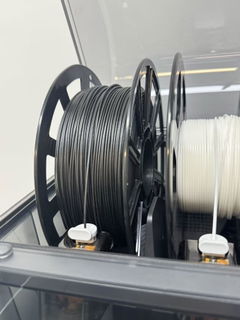
Filament with spool