- Home
- All Filaments
- TPU-70A Matte Filament – Rubber-Like Softness, 1.75mm, 1kg
1
/
of
12
Free Shipping
15-Day Easy Returns
Lifetime Product Support
Secure Payment

Ends in
00
D
:
00
H
:
00
M
:
00
S
TPU-70A Matte Filament – Rubber-Like Softness, 1.75mm, 1kg
$34.42
/roll
(Lowest price for 20+ rolls)
MSRP:$45.90
Save $11.48 per kg
Buy more, save more.
View bulk pricing ›
1 pcs
Free Shipping
5 pcs
$39.01
15% OFF
10 pcs
$36.72
20% OFF
20 pcs
$34.42
25% OFF
0 rolls
Color
Quantity
Price

Black
Sold out—

White
Sold out—

Orange
Sold out—

Parrot Green
Sold out—

Red
Sold out—

Skin
Sold out—

Blue
Sold out—

Yellow
Sold out—

Tender Green
Sold out—

Sky Blue
Sold out—

Translucent
Sold out—

Gray
Sold out—
Subtotal
0 items
📍 Your location: United States
Black —Ships internationally
Estimated Sep 24 – Oct 6
Couldn't load pickup availability
Payment
Filazoo TPU-70A Matte is a 1.75 mm flexible 3D printing filament designed for maximum softness for demanding rubber-like prototypes. Its matte formulation produces a low-gloss surface that softens reflections and makes layer lines less noticeable. It is suited to functional prototypes and end-use parts that need controlled flex, impact absorption, and repeated handling.
Key Features
- 70A Shore hardness for extra-soft, rubber-like flexibility
- Matte appearance tailored to functional and creative parts
- Strong layer bonding and resilient impact response
- Abrasion-resistant TPU performance for frequently handled components
- Low-warp printing behavior when the filament path is properly configured
- Low-gloss finish helps reduce the visual impact of layer lines
Recommended Applications
- Ultra-soft prototypes
- Flexible membranes
- Comfort components
- Soft seals
- Highly elastic parts
For best results, keep the filament dry, use a short and constrained filament path, and begin with the recommended settings before calibrating flow, temperature, and retraction for your printer.
Share
Need to Know
Product Features
Service
- Free Shipping
- 15-Day Easy Returns
- Lifetime Product Support
Payment
Secure checkout is available with these payment methods:


TPU-70A Matte Filament – Rubber-Like Softness, 1.75mm, 1kg
$45.90
Subtotal:
$45.90
$45.90
Related Model
-
-
-
Farmhouse Coin Bank
23 4 -
Rocket Stress Relief Toy
20k 215
Overview
Shore 70A · Rubber-Like · 1.75mm · 1kg
TPU 70A Matte Filament for Ultra-Soft Prototypes, Membranes & Seals
FAQ
What does 70A Shore hardness mean?
Shore A measures resistance to indentation — the lower the number, the softer the material. At 70A this is the softest grade we stock: genuinely rubber-like, easy to compress, and best suited to cushioning, gaskets, and squeezable parts. It's also the most demanding to feed, so a direct-drive extruder and slow, steady printing matter more here than on any other grade. TPU Shore hardness explained: 70A vs. 80A vs. 85A vs. 90A vs. 95A walks through which grade fits which project.
Should I dry this TPU before printing?
Yes — TPU is hygroscopic and picks up moisture faster than most filaments. Dry it as soon as you hear popping or see bubbles, heavy stringing, weak layers, or a rough surface, and print from dry storage whenever you can. How to dry filament at home compares ovens, dry boxes, and dedicated dryers; how to store filament properly covers keeping it dry between prints.
Can I print it with a Bowden extruder?
Direct drive is required for this grade. It is too soft to push through a long Bowden tube — the filament coils inside the path instead of advancing. Use a short, constrained route with very low spool resistance. TPU Shore hardness explained covers which grades tolerate which extruder setups.
Why is my TPU stringing?
Moisture is the usual culprit. Dry the filament first — how to dry filament at home covers the options — then lower the nozzle temperature or adjust retraction carefully and keep travel moves efficient. TPU needs a different retraction approach from rigid filaments, which our step-by-step retraction tuning guide covers material by material.
Can I use an automatic material system?
It depends on your printer and feeder. Flexible TPU can buckle or jam in the long feed paths these systems use, so run it from an external spool with a direct feed unless your equipment manufacturer explicitly supports this hardness. Our AMS and multi-material setup walkthrough covers what to check before loading a flexible spool.
How can I improve dimensional accuracy?
Print slowly, calibrate flow, limit acceleration, keep the filament dry, and avoid building excessive pressure at the nozzle. Always test a small calibration part before committing to a production run — what a calibration print tells you explains how to read the result rather than just eyeballing it.
What's in the Box
* The color and texture of the filament are subject to the physical product. Images are for reference only.
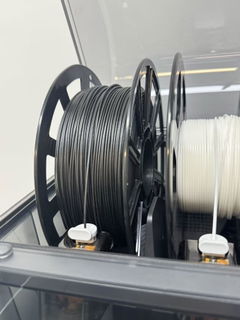
Filament with spool