- Home
- All Filaments
- PLA UV Color-Changing Filament – Photochromic, Sunlight-Reactive, 1.75mm, 1kg
1
/
of
3
Free Shipping
15-Day Easy Returns
Lifetime Product Support
Secure Payment

Ends in
00
D
:
00
H
:
00
M
:
00
S
PLA UV Color-Changing Filament – Photochromic, Sunlight-Reactive, 1.75mm, 1kg
$16.42
/roll
(Lowest price for 20+ rolls)
MSRP:$21.90
Save $5.48 per kg
Buy more, save more.
View bulk pricing ›
1 pcs
Free Shipping
5 pcs
$18.61
15% OFF
10 pcs
$17.52
20% OFF
20 pcs
$16.42
25% OFF
0 rolls
Color
Quantity
Price

Blue
Fast delivery

Purplish red
Fast delivery
Subtotal
0 items
📍 Your location: United States
Fast USA ShippingBlue —In stock in USA
Order today → Estimated Sep 17–24
Couldn't load pickup availability
Payment
Watch your 3D prints transform in sunlight with Filazoo PLA UV Color-Changing Filament. Its photochromic formula changes from a pale, nearly neutral appearance to a more vivid color when exposed to sunlight or UV light, then gradually returns to its original appearance when the UV source is removed.
Combining this interactive effect with the straightforward printing characteristics of PLA, it is ideal for jewelry, toys, accessories, cosplay props, educational models, outdoor-reveal designs, decorations, and creative projects.
Key Features
- Changes color when exposed to sunlight or UV light
- Gradually returns to its original color away from UV exposure
- Reversible photochromic effect
- Color intensity responds to UV strength and exposure time
- Easy-printing PLA base
- Low warping under suitable printing conditions
- Smooth and consistent extrusion
- No batteries, heat, or electronic components required
- Suitable for standard single-nozzle printers
- Available in Blue and Purplish Red
- Ideal for interactive and light-responsive creations
- Suitable for beginners and experienced makers
Diameter:
1.75 ± 0.02 mm*
Net Weight:
1 kg per spool
Gross Weight:
Approximately 1.3 kg per spool*
Filament Length:
Approximately 330–340 m*
Important Color-Change Note:
The strength and speed of the color change depend on UV intensity, exposure duration, the selected color, model thickness, surface finish, and environmental conditions. Direct sunlight or a suitable UV lamp will generally produce a more noticeable response than normal indoor lighting.
Care Tip:
Store the filament sealed with fresh desiccant in a cool, dry, dark environment. Extended UV exposure during storage may affect the material’s appearance and photochromic performance.
Share
Need to Know
Product Features
Service
- Free Shipping
- 15-Day Easy Returns
- Lifetime Product Support
Payment
Secure checkout is available with these payment methods:


PLA UV Color-Changing Filament – Photochromic, Sunlight-Reactive, 1.75mm, 1kg
$21.90
Subtotal:
$21.90
$21.90
Related Model
-
-
-
Farmhouse Coin Bank
23 4 -
Rocket Stress Relief Toy
20k 215
FAQ
Does it require direct sunlight?
Not necessarily — a suitable UV lamp activates it just as well. Sunlight is simply the most convenient source, though its strength varies with weather, season, location, and time of day. How UV color-changing PLA actually works explains what the material is responding to.
Does it glow in the dark?
No — these are two different mechanisms. UV color-changing filament shifts its visible color while UV light hits it; glow-in-the-dark filament stores light and releases it in darkness. Glow-in-the-dark and UV color-changing PLA: how these special-effect filaments actually work compares them directly.
Is it temperature color-changing filament?
No. This is a photochromic material — it reacts to ultraviolet light, not to heat. Thermochromic (temperature-reactive) filament is a different product entirely. How these special-effect filaments actually work explains the difference.
Is the color change reversible?
Yes. The color deepens under UV exposure and fades back toward its inactive appearance once the UV source is removed, and the cycle repeats. How UV color-changing PLA actually works covers the chemistry behind the reversal.
How quickly does it change color?
Quickly enough to be visible as you carry a print outdoors — usually seconds to a minute or so in strong sun. The exact response depends on UV strength, distance from the source, exposure time, the variant, model geometry, and conditions on the day. How UV color-changing PLA actually works explains what drives the speed.
Why is the color change weak?
Usually not enough UV reaching the material: weak or indirect light, UV-filtering window glass, too short an exposure, or an opaque coating. Test the model outdoors in direct sunlight or under a proper UV lamp before concluding anything — indoor light is rarely enough.
Will the color-changing effect last forever?
No. Photochromic additives gradually lose performance with age, repeated cycling, heat, and prolonged outdoor exposure — that's true of all photochromic materials. Keeping prints out of permanent direct sun extends their working life considerably. How these special-effect filaments actually work explains why.
Can I paint or coat the finished model?
You can, but opaque paint and UV-blocking coatings stop light reaching the photochromic layer and kill the effect. Leave the color-changing areas uncovered, or test a UV-transmitting clear coat on a sample first.
Can I use it outdoors permanently?
It's built for sunlight demonstrations and decorative use rather than permanent outdoor installation. Continuous exposure accelerates fading and aging of the photochromic additive, and PLA itself deforms in sustained heat. For parts that live outside, see best weather-resistant filament picks.
Is a hardened nozzle required?
No. Photochromic PLA isn't abrasive the way glow or carbon-fiber filaments are, so a standard 0.4mm brass nozzle is fine. Brass vs. hardened steel explains which filaments genuinely need the upgrade — this isn't one of them.
Does it change color under normal indoor lighting?
Usually not much. Most window glass and indoor lamps put out very little UV, so the effect looks weak or invisible indoors. Direct sunlight or a UV lamp gives a far stronger result — take the print outside to see what it really does.
How long does it take to return to its original color?
Typically a minute or two out of the light, though it varies with the formulation, how deeply the color was activated, ambient conditions, and how long the UV exposure lasted. A deeply charged print takes noticeably longer to fade back than a briefly exposed one.
Does stronger sunlight create a darker color?
Generally yes — stronger UV and longer exposure give a deeper activated color, up to the point where the photochromic additive saturates. Overcast daylight produces a visible but milder shift than direct summer sun. How UV color-changing PLA actually works covers the mechanism.
How does PLA UV Color-Changing filament work?
Photochromic additives in the filament respond to ultraviolet radiation. Under sunlight or a UV lamp the printed model develops a stronger color, then drifts back toward its original appearance once the UV goes away. Glow-in-the-dark and UV color-changing PLA: how these special-effect filaments actually work explains the chemistry, and glow and UV prints for Halloween and party décor has project ideas.
What's in the Box
* The color and texture of the filament are subject to the physical product. Images are for reference only.
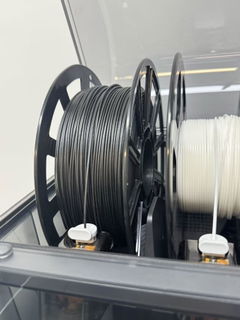
Filament with spool